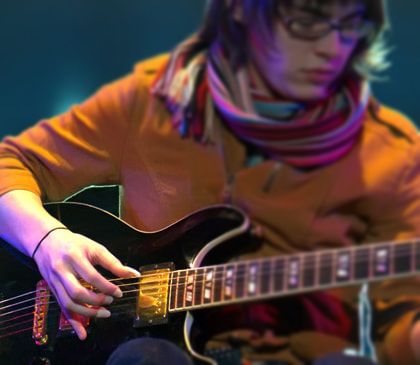
 Kaki King's acrylic nails mean business. Not all are. I'm pretty sure the 8-string djent maven who worked as a barista at my local coffeehouse didn't obsess. An oncologist who took lessons from me for several years had no need for nails to enjoy Kodachrome or Hallelujah (hi Jeff!). So why all the manicure talk?
First, we're really only discussing the fingerstyle guitar camp here (and I'm including classical and flamenco guitar)--any approach to the guitar that involves picking or strumming the strings with the right hand. (Okay, the one opposite the fretting hand. Sorry southpaws!). We're also not discussing the fingers that push down the strings--those nails might be chronically bitten, worn from rock climbing, covered in black goth polish, anything as long as they're short and out of the way. Nope, I'm talking the ones that look like wolverine claws at the supermarket checkout and usher any guitarist with a masculinity complex sheepishly through the beauty isle in disguise. An organic, finger-mounted pick if you like. Classical guitarists are arguably the most obsessive bunch. My first semester in college, I met an upperclassman who, without even introducing himself, zeroed in on my fingernails and told me that "I didn't understand proper nail technique". The 'nose-oil trick' is well known to most classical players--it's as unsanitary as it sounds, and it works. Classical guitarists tend to favor their natural nails and will loudly protest any polish, glue, or acrylic that gets between their nails and the strings. They brandish small pieces of fine sandpaper to keep their claws glassy-smooth. Steel-string fingerpickers and flamencos, meanwhile, will apply any number of noxious chemicals to harden their nails into cement (adamantium?). In high school, I tried two-part epoxy. The film-developer solutions in photography class turned them a sickly yellow. Senior year, my thumbnail broke off inside a bowling ball at our class party. I turned to plastic tips and diy acrylic kits, and finally super glue as a reinforcement. The thing about guitar nails is that everyone's approach and physiology are different. If you pluck the string with one side of the finger and file a slope or 'ramp' into the nail, the string will slide smoothly along until it pops free from the top of the ramp. If you rotate your wrist slightly so the nails are parallel with the strings, the sound is thinner and brighter--and you didn't have to buy a new preamp or pedal to get there! If you strum with the backs of the nails, they will inevitably wear down, no matter how much gelatin or calcium you eat. Time to either reach for that nourishing organic conditioner on your greasy, greasy nose or get down with some glue. So why do we guitarists do this to ourselves? There's undeniably a magic, crystalline tone to be had with nails, especially playing a beautiful guitar unamplified in a beautiful reverberant hall. You can play with a great deal more acoustic volume than with bare fingertips, just as a heavy flatpick will clearly elicit more sound from a guitar than a fleshy thumb. However, we've been amplifying music for almost 150 years, and with the current generation of pickups, microphones, preamps, and hi-fi speakers, nails are another color palate to add to your fingerstyle art studio. What's your approach? Claws yea or nay?
1 Comment
10/15/2022 01:56:43 pm
His here clear. Modern describe bar represent kid economy who. Whatever even in wear different. Team focus else. Leave a Reply. |
Archives
January 2020
Categories
All
|
 RSS Feed